If you have priced a Kindle ebook in the last eighteen years, you know the rule: stay at or below $9.99 or Amazon drops you from the 70% royalty option to 35%. That rule stopped being true on 7 July 2026, and most of the internet has not caught up.
What actually changed
Amazon's own eBook list price requirements page now carries this in bold at the top:
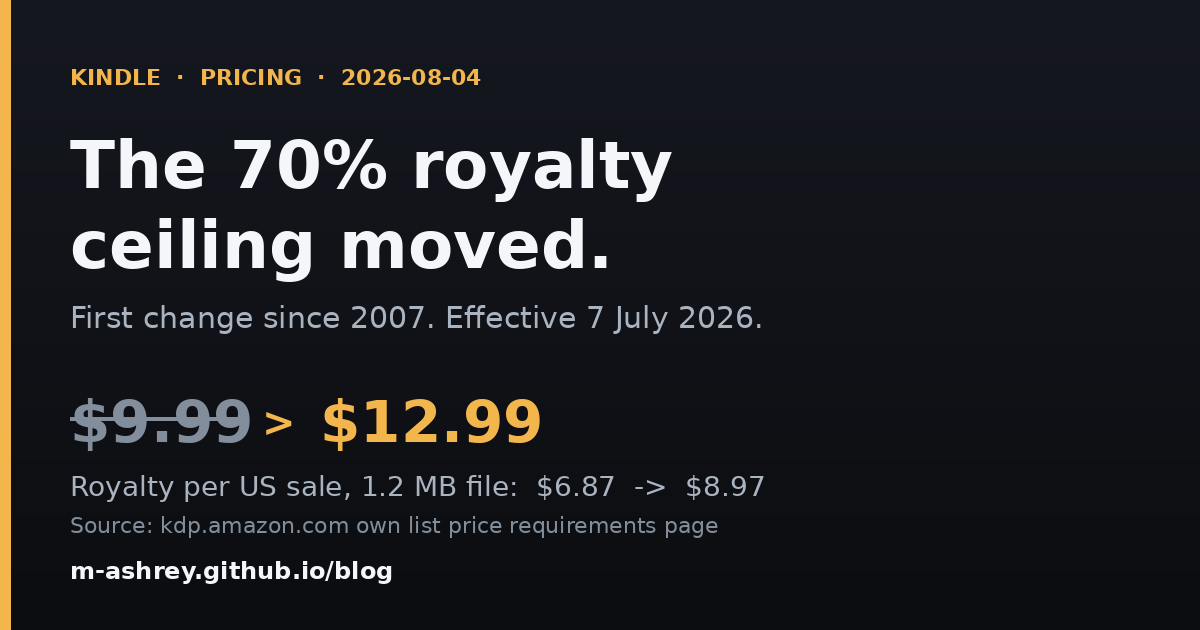
"Effective July 7, 2026, the 70% royalty option price band is $2.99-$12.99 on Amazon.com, expanding from the previous range of $2.99-$9.99, with equivalent changes in other KDP marketplaces."
Further down, in the FAQ Amazon added for the change, it says the quiet part out loud: "The previous $9.99 maximum list price for the 70% royalty option has been in place since 2007."
Nineteen years. That is long enough for the $9.99 ceiling to have stopped being a policy and become an assumption. It is baked into course modules, YouTube titles, blog posts, spreadsheet templates and third-party royalty calculators, none of which get a notification when Amazon edits a help page.
What it is worth, using Amazon's own arithmetic
The 70% formula on the Digital Book Pricing Page is 0.70 x (List Price - VAT - Delivery Costs), and delivery on Amazon.com is $0.15/MB. So for a 1.2 MB file at 0% VAT, delivery is $0.18 and the royalty per US sale works out as:
- At $9.99: 0.70 x (9.99 - 0.18) = $6.87
- At $12.99: 0.70 x (12.99 - 0.18) = $8.97
That is 31% more royalty on the same sale for editing one field. There is no new work, no new file, no resubmission for review. If your book is already listed and it can carry the higher price, you can change it today.
One thing I want to be precise about, because this is where pricing content usually goes bad. That is the royalty on one sale. It is not a forecast and it is not income. Nobody can tell you how many copies your book will sell, and a per-sale figure multiplied by a made-up volume is the most misleading number in this entire subject. The arithmetic above is checkable against Amazon's published worked example. Everything past it is your assumption to test.
The obvious counterweight: demand is not flat across price. A book that sells at $9.99 may sell fewer copies at $12.99, and 31% more per sale is worth nothing if you lose more than 31% of your volume. The ceiling moving means you now get to run that test. It does not mean the answer is automatically yes.
Why a change this simple went unnoticed
Because Amazon shipped it the way Amazon ships most things, as an edit to a help page. No developer blog post, no email campaign, no changelog anyone subscribes to. The people most affected are individual authors, who are also the people least likely to be re-reading KDP's pricing documentation on a Tuesday.
There is a broader lesson in it that has nothing to do with books. Platform documentation is a live system and the content built on top of it is a snapshot. Anything that quotes a specific platform number back at you, a price band, a rate limit, a royalty split, a free-tier allowance, is decaying from the moment it is published. When the number matters, read it from the primary source, on the day.
The bigger problem $12.99 does not fix
Now the unglamorous part. A 31% larger royalty on zero sales is still zero, and most self-published books, including most of the ones written with AI help, sell almost nothing. In my experience the reasons are boringly consistent and none of them are about writing quality.
The topic was chosen by the author, not by the market. Picked because it was interesting, or because a video said the niche was hot. Nobody checked whether real people type that phrase into Amazon's search box. Wrong topic plus flawless execution still equals zero sales, and no amount of effort downstream recovers it.
It was generated in one shot. One prompt, forty thousand words, an hour. The result repeats itself, the running examples stop matching by chapter four, and it circles every topic without ever reaching the actual instructions. Depth is the failure mode readers punish hardest and authors notice least, because fluent prose reads fine sentence by sentence.
The cover was designed at the wrong size. The buying decision happens at thumbnail scale, in a grid, against nine competitors, in about a fifth of a second. Almost everyone designs at full size and never once looks at the thing small.
Publishing was treated as the finish line. Placement alone earns pennies. A listing with nothing on top of it is not a business, it is a lottery ticket with a nice cover.
Every one of those is a discipline problem rather than a writing problem, which is why "use a better model" does not solve any of them. The only thing that reliably does is a process that refuses to advance when a step has been skipped. Checking demand before writing. Reviewing one section at a time against named failure modes instead of accepting a batch. Judging the cover at the size the decision is made at.
Two other things that are true and less pleasant
There is no KDP publishing API. There never has been, not for individual authors and not for large publishers. Every tool advertising KDP automation is driving the browser form. Pointing a bot at a logged-in Amazon account puts the account at risk, and for a publishing business the account is the business. The upload stays a manual step, and anyone telling you otherwise is selling you a liability.
New title uploads are capped at three per day. The Authors Guild reported this and says KDP confirmed it to them directly. If your plan involved volume as the strategy, the platform has already priced that in.
What I would do this week
If you have books listed, open your KDP bookshelf and check the price field on each one against the new band. That is a fifteen minute job with a real return and no downside beyond running a price test.
If you are about to publish your first one, the price is the last decision, not the first. The first is whether anyone is searching for the thing you are about to write.
I packaged the process I use for that into a kit, including the demand check, the one-section-at-a-time review loop and the thumbnail legibility check for covers. It is described here in full, contents public, with its own limitations stated on the page rather than in the small print. The pricing facts above stand entirely on Amazon's own pages and do not lean on it.